Why CaptchaAI Is the Best CAPTCHA Solver for Proxy Users in 2026
Compare CaptchaAI with 2Captcha, Anti-Captcha, and CapSolver—and see why unlimited solving, flexible integrations, and lower costs at scale make CaptchaAI the strongest overall choice for regular proxy workflows.
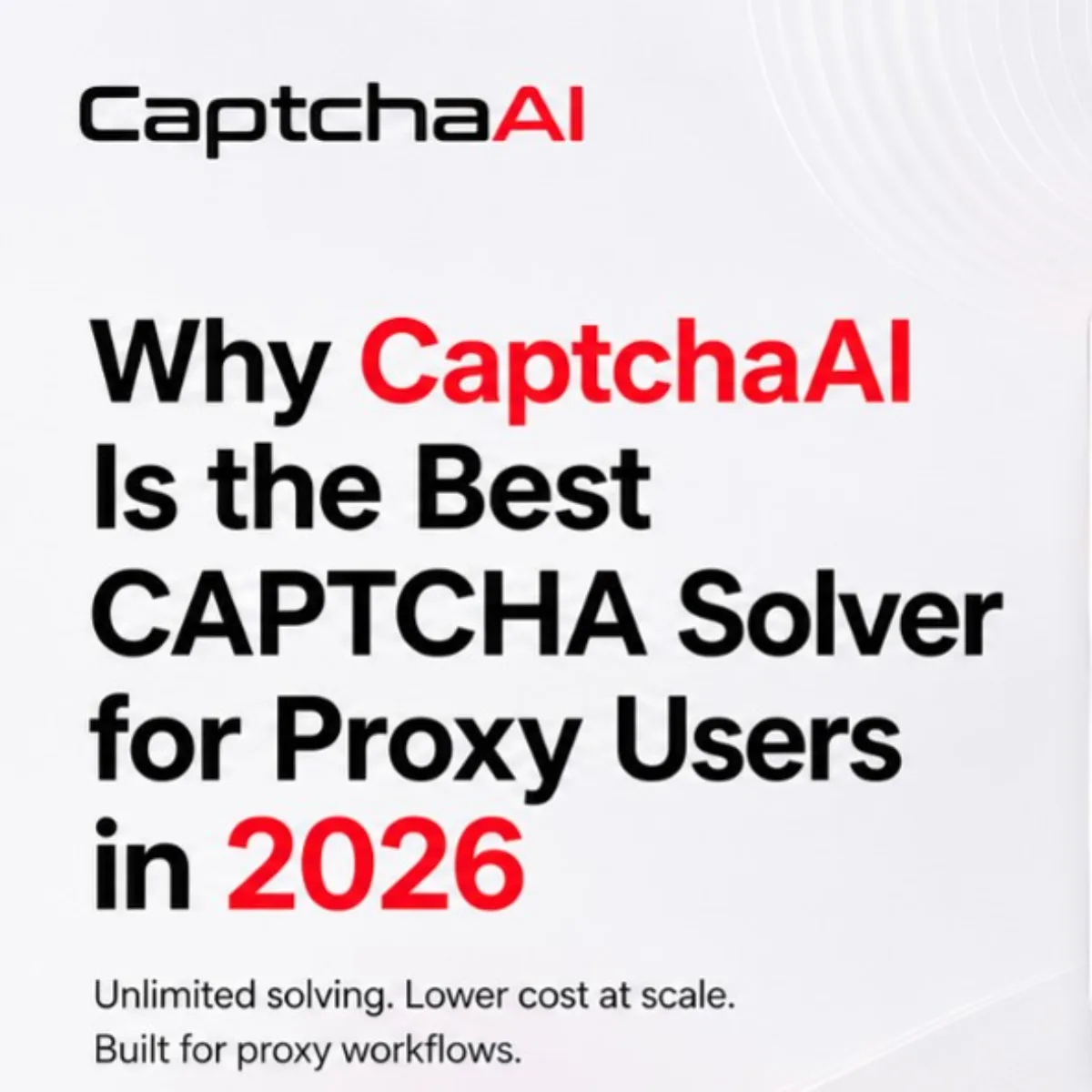
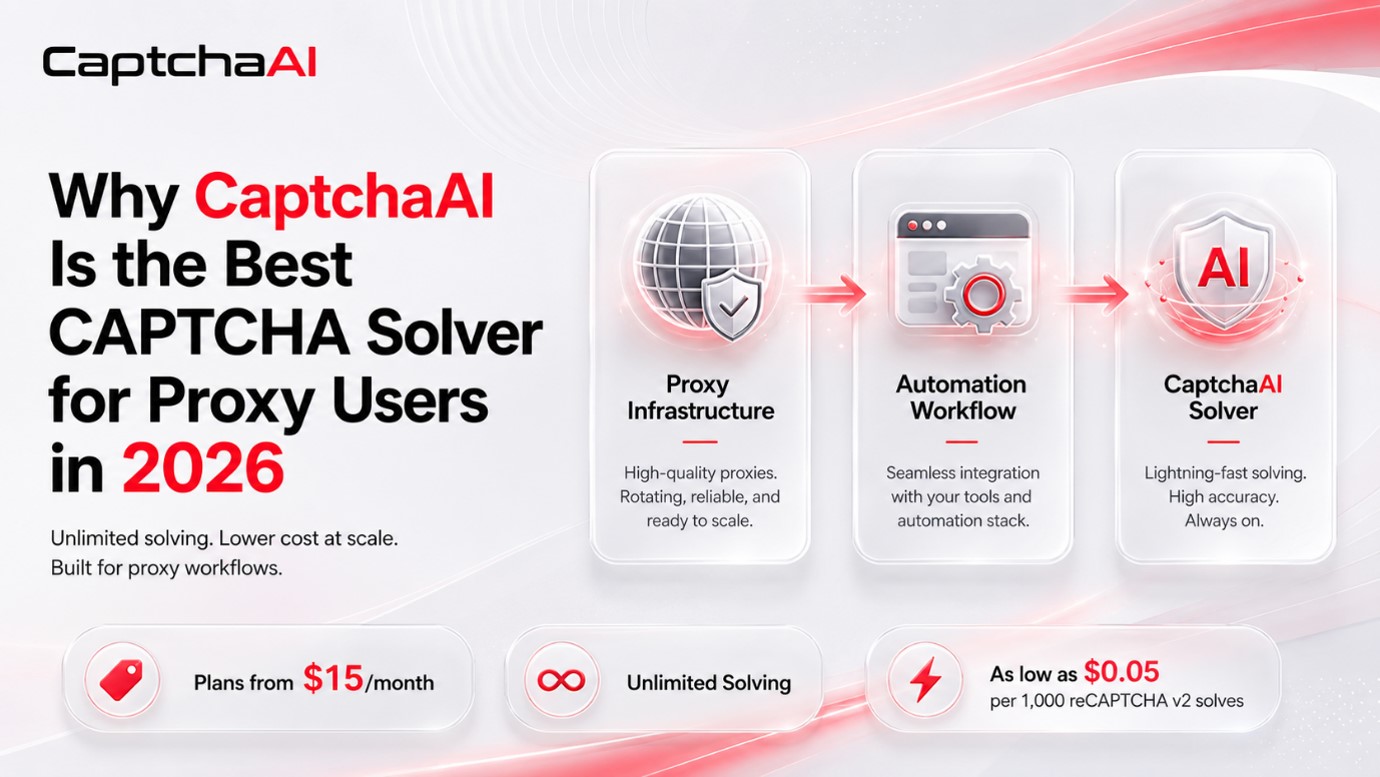
Proxy infrastructure helps automation teams manage IP locations, maintain sessions, test applications, collect authorized data, and operate browser-based workflows. However, even a stable residential, mobile, ISP, or datacenter proxy cannot process a CAPTCHA when one interrupts the next step.
That requires a separate CAPTCHA-solving layer:
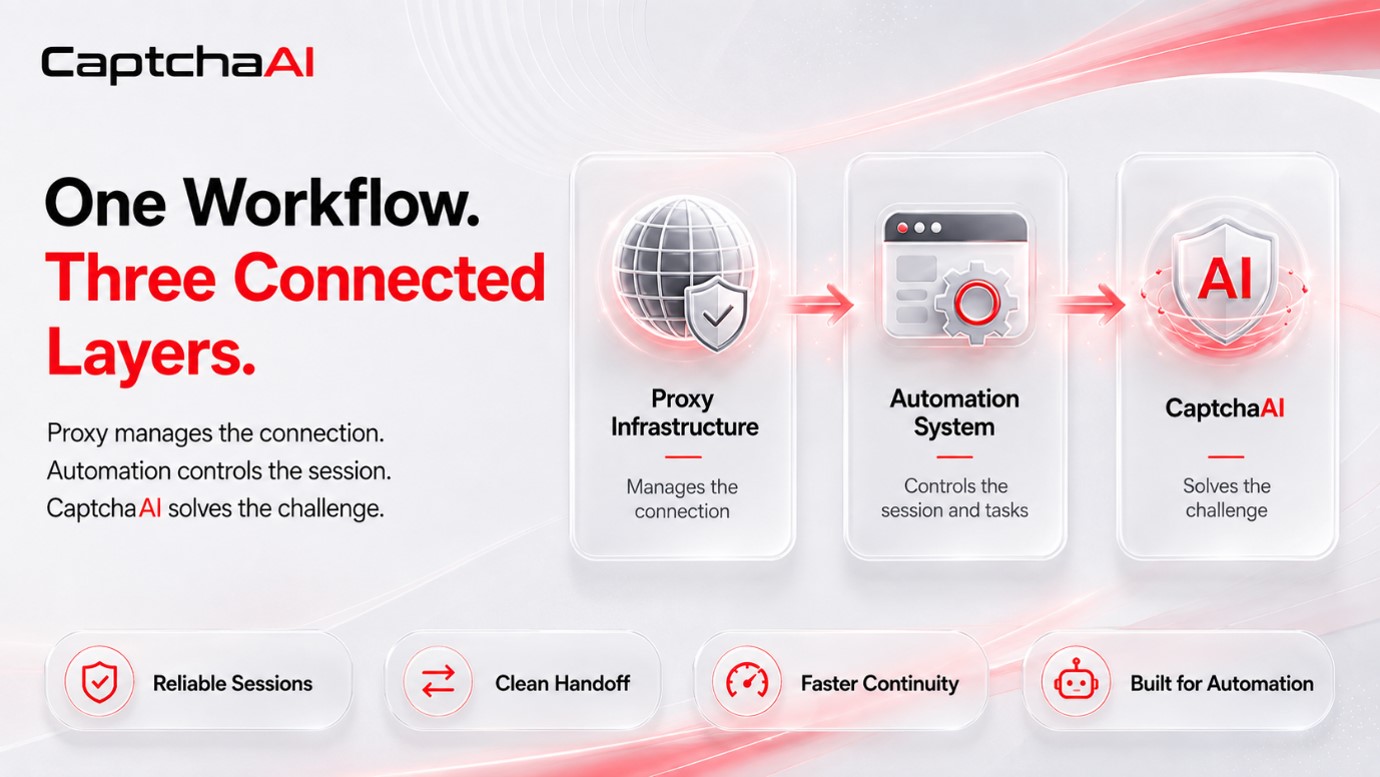
• The proxy manages the IP address and network route.
• The automation platform controls the browser, session, and task logic.
• The CAPTCHA solver processes the supported challenge.
Choosing the right solver therefore requires more than comparing a single advertised rate. Proxy users should consider CAPTCHA coverage, proxy compatibility, integration options, concurrent capacity, and the real cost as usage grows.
Several established services address parts of these requirements. 2Captcha provides broad challenge coverage, Anti-Captcha offers detailed task configuration, and CapSolver provides competitive pay-per-use pricing.
CaptchaAI combines these core capabilities with something the main alternatives do not offer in the same way: unlimited solving within reusable thread capacity, without charging separately for every completed CAPTCHA.
For regular proxy workflows, that combination gives CaptchaAI the strongest overall balance of coverage, scalability, integration flexibility, and cost predictability.
CAPTCHA Solvers at a Glance
Service Pricing Model Main Strength Main Limitation Best Fit
CaptchaAI Monthly subscription based on concurrent threads Unlimited solving, predictable costs, broad coverage, and flexible integrations Monthly subscription may not suit very light usage Regular and high-volume proxy workflows
2Captcha Pay per completed task Broad CAPTCHA coverage and mature integrations Spending increases with every completed solve Occasional use and uncommon CAPTCHA types
Anti-Captcha Pay per completed task Granular task configuration and proxy controls More technical setup and volume-based spending Experienced development teams
CapSolver Pay per request or token Competitive direct rates and automated processing No unlimited monthly solving model Low-to-medium-volume workloads
This comparison is based on publicly documented features and pricing. It is not an independent performance benchmark. Results may vary according to CAPTCHA implementation, proxy quality, browser context, traffic patterns, and final acceptance by the destination.
What Proxy Users Actually Need
Consistent Proxy and Session Context
Some CAPTCHA challenges can be processed without passing the customer’s proxy to the solver. Others require the result to be generated using the same IP address that originally loaded the protected page.
When IP matching is required, the workflow may need to preserve:
• Proxy IP
• Cookies
• User-Agent
• Browser profile
• Page URL
• Site-specific parameters
• Original session context
A solver can return a technically valid token that the destination still rejects because the proxy changed, the session expired, or the result was submitted from a different browser environment.
Support for Multiple CAPTCHA Types
Proxy users do not always encounter the same verification system.
One project may use reCAPTCHA v2, while another requires reCAPTCHA v3, Cloudflare Turnstile, Cloudflare Challenge, GeeTest, BLS, or an image-based CAPTCHA.
Maintaining separate providers, balances, and integrations for every CAPTCHA family creates unnecessary operational complexity. A stronger platform should cover several common challenge types through one account and a consistent integration workflow.
Capacity During Traffic Peaks
Monthly volume and simultaneous demand are not the same.
One workflow may process 100,000 CAPTCHAs gradually throughout the month. Another may process fewer total tasks but receive hundreds at the same moment.
Pay-per-solve services primarily scale their cost according to total completed volume. CaptchaAI scales according to the number of tasks that must be processed concurrently.
That distinction becomes especially important as automation volume grows.
Why CaptchaAI Leads the Comparison
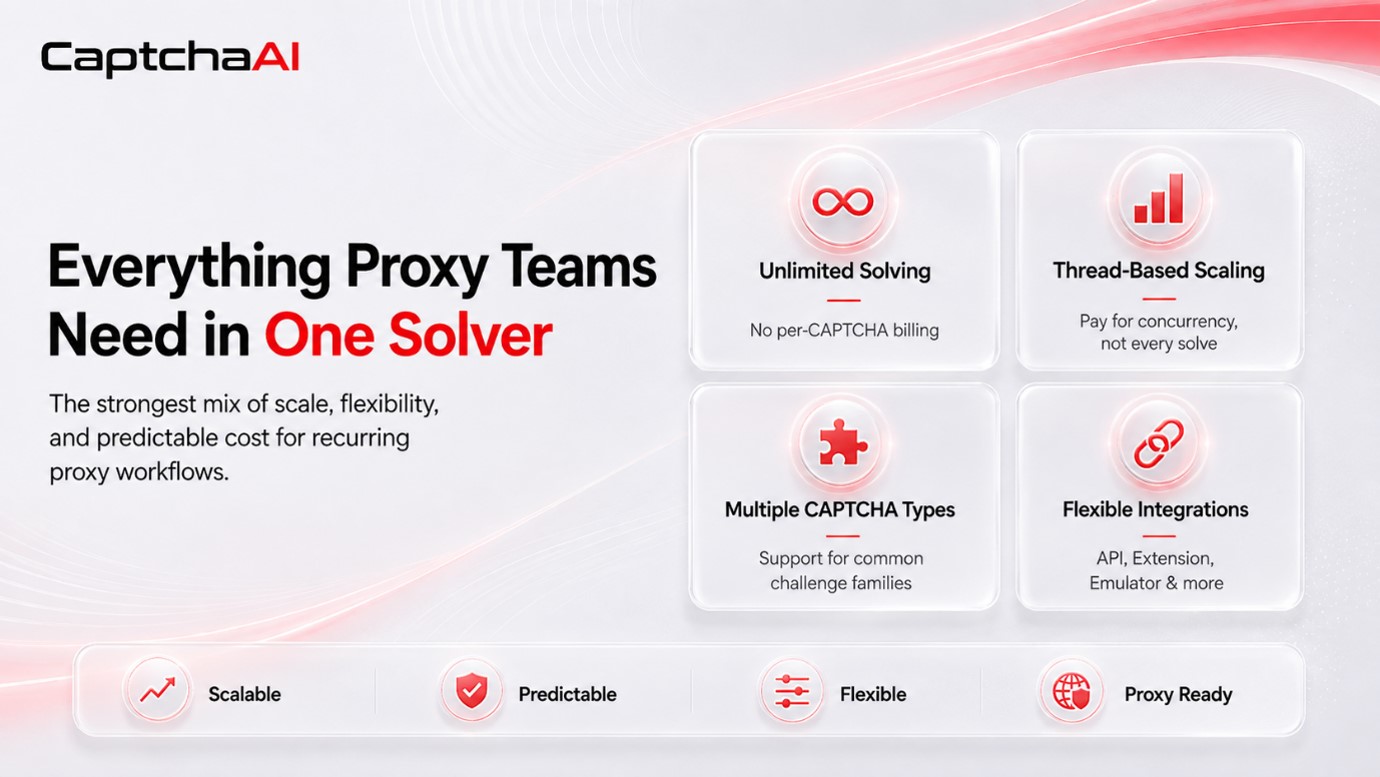
CaptchaAI combines the features proxy users typically evaluate across several providers:
• Plans starting from $15 per month
• Unlimited solving in every plan
• No separate per-CAPTCHA billing
• Thread-based concurrent capacity
• Multiple supported CAPTCHA families
• Proxy support for compatible workflows
• Direct API access
• Chrome extension
• Windows Emulator
• Compatibility options for third-party software
• A three-day trial with five threads
Its main advantage is not based on one isolated feature. It is the way these capabilities work together under a predictable subscription model.
Unlimited Solving Through Reusable Threads
CaptchaAI charges for concurrent capacity rather than charging for each individual result.
One Captcha Thread processes one active task at a time. When that task finishes, the same thread becomes available for another request.
Current monthly plans include:
Plan Monthly Price Concurrent Threads
Basic $15 5
Standard $30 15
Advance $90 50
Premium $170 100
Corporate $240 150
Enterprise $300 200
VIP plans extend the available capacity to 1,000, 3,000, and 5,000 concurrent threads. Every plan includes unlimited solving within its active thread capacity.
Unlimited solving does not mean unlimited simultaneous tasks. A five-thread plan can process up to five active requests at one time. However, those five threads can be reused continuously as earlier tasks finish.
This removes the direct relationship between the number of CAPTCHAs solved and the monthly bill. Instead of paying more for every additional batch, teams select a plan according to their peak concurrent demand.
Pricing at Scale
2Captcha, Anti-Captcha, and CapSolver primarily use pay-per-task pricing.
Their currently published standard reCAPTCHA v2 rates are approximately:
• 2Captcha: $1–$2.99 per 1,000
• Anti-Captcha: $0.95–$2 per 1,000
• CapSolver: $0.80 per 1,000
The following table illustrates how those rates can affect monthly spending. CaptchaAI examples are conditional because the required plan depends on peak concurrency and task duration, not monthly volume alone.
Monthly reCAPTCHA v2 Volume 2Captcha Anti-Captcha CapSolver CaptchaAI Illustration
10,000 solves $10–$29.90 $9.50–$20 $8 $15 Basic, provided five threads meet the workload
100,000 solves $100–$299 $95–$200 $80 $15 Basic, provided concurrency and throughput remain within capacity
1,000,000 solves $1,000–$2,990 $950–$2,000 $800 $90 Advance, provided 50 threads meet peak demand
The pay-per-solve estimates multiply the published standard rate by the listed volume. They do not include retries, discounts, failed attempts, dynamic pricing, taxes, or custom enterprise agreements.
At 10,000 monthly tasks, CapSolver’s published rate may produce a lower total bill than CaptchaAI’s $15 Basic subscription. This makes pay-as-you-go billing practical for very small or irregular workloads.
The difference changes as volume grows.
A pay-per-solve provider continues charging for every additional 1,000 tasks. CaptchaAI continues charging for the subscribed thread capacity as long as the workflow remains within that capacity.
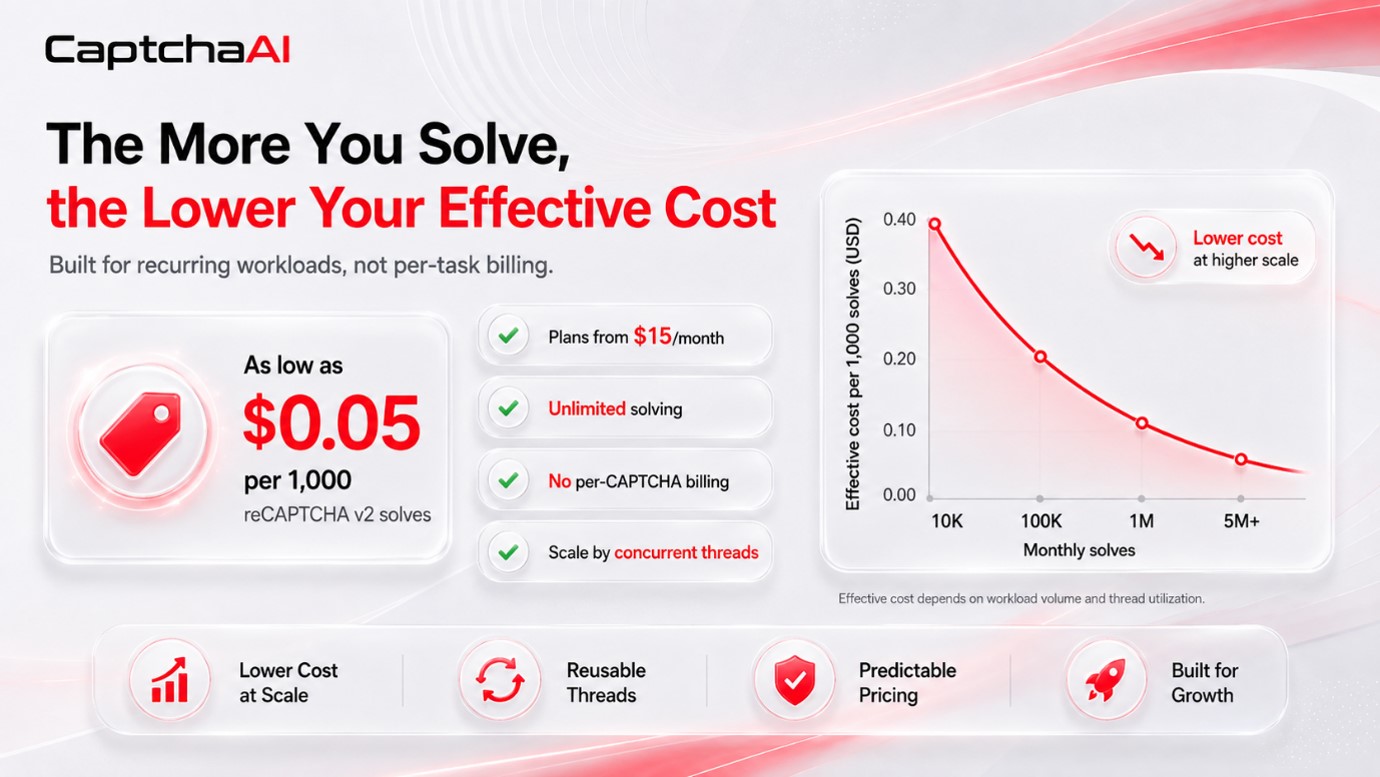
CaptchaAI publishes an effective reCAPTCHA v2 cost of as low as $0.05 per 1,000 solves, alongside a thread-based subscription and no per-CAPTCHA billing. It also publishes a reCAPTCHA v2 success rate above 99.5% and a typical solving time below 60 seconds. These are provider-published figures rather than results from an independent benchmark.
The $0.05 figure is not a separate rate charged for every 1,000 tasks. It is an effective cost that can be reached when teams process sufficient volume through their subscribed thread capacity.
This produces a clear distinction:
• Pay-per-solve services can cost less for occasional usage.
• CaptchaAI becomes increasingly competitive as the same threads are reused.
• High-volume teams can reduce their effective cost without paying separately for every result.
• The correct CaptchaAI plan must still be selected according to peak concurrency.
For sustained workloads, this is where CaptchaAI’s pricing advantage becomes most visible.
Multiple CAPTCHA Types Through One Account
CaptchaAI supports a broad range of common CAPTCHA families, including:
• Image and text CAPTCHA
• Grid Image CAPTCHA
• reCAPTCHA v2
• Invisible reCAPTCHA v2
• reCAPTCHA v2 Enterprise
• reCAPTCHA v3
• reCAPTCHA v3 Enterprise
• Cloudflare Turnstile
• Cloudflare Challenge
• GeeTest v3
• BLS CAPTCHA
• CaptchaFox
• Friendly Captcha
• Lemin
The service also supports more than 27,500 image-based CAPTCHA formats, including Solve Media and other custom image challenges.
This coverage allows teams to use one subscription across multiple supported workflows instead of funding and maintaining a different provider for every project.
Flexible Integration Options
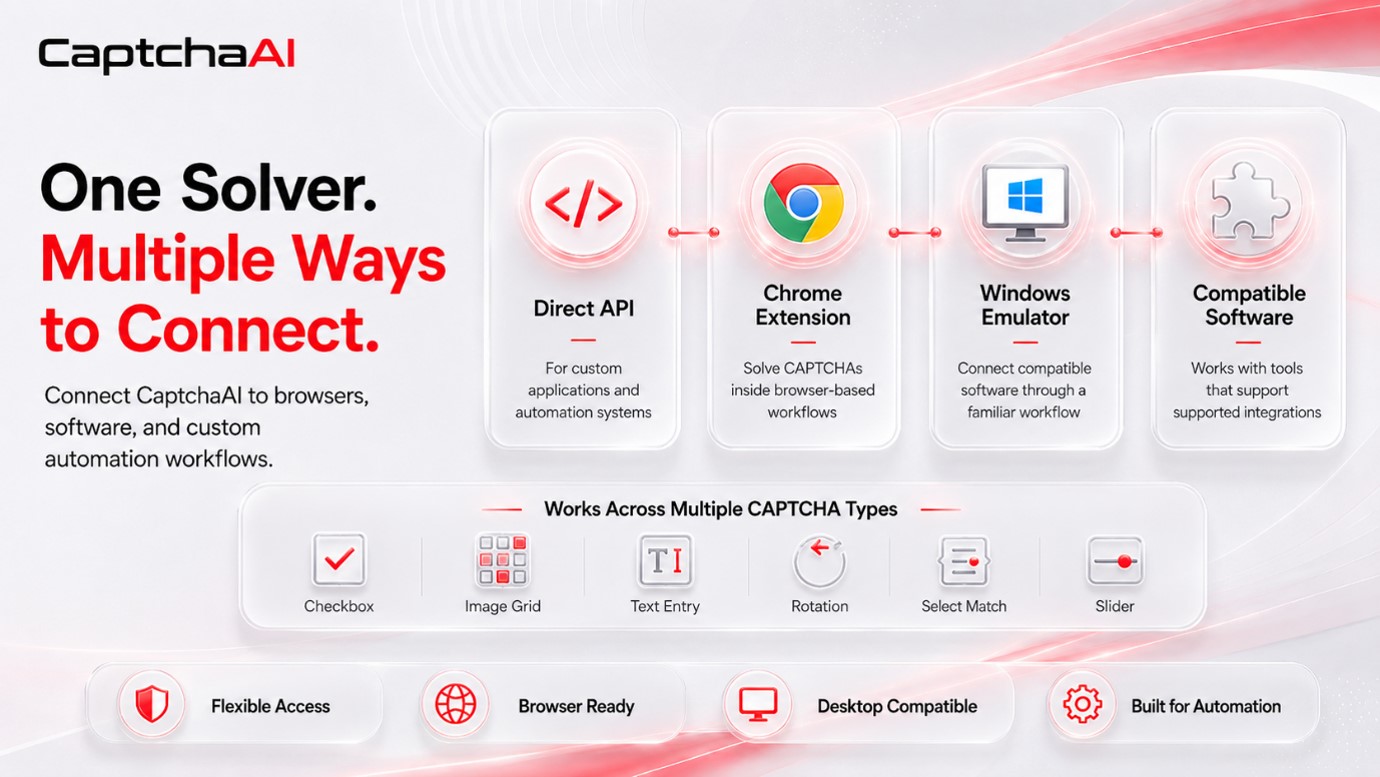
CaptchaAI provides several routes for adding CAPTCHA solving to an existing stack.
Direct API
The API is suitable for custom scripts, backend applications, task queues, browser automation tools, and internal systems.
Chrome Extension
The CaptchaAI Chrome extension can process supported challenges directly inside browser-based workflows. Its current controls include reCAPTCHA v2, reCAPTCHA v3, Turnstile, GeeTest v3, BLS, and normal image CAPTCHA.
Windows Emulator
The Windows Emulator simulates 2Captcha services and redirects compatible software requests to the user’s CaptchaAI account. This can provide an integration route when a tool supports 2Captcha but does not list CaptchaAI directly.
Compatible Third-Party Software
When CaptchaAI is available as a native option, users can select it and enter their API key. When only 2Captcha compatibility is available, the Emulator or a compatible custom-server option may provide an alternative connection method.
These options mean teams can integrate CaptchaAI according to their existing environment instead of rebuilding the rest of their automation stack.
Proxy Support
CaptchaAI supports HTTP, HTTPS, SOCKS4, and SOCKS5 proxies. Its browser-extension guidance also documents proxy type, address, port, and credential configuration.
Proxy functionality is disabled by default and must be activated through support. CaptchaAI’s current proxy guide recommends using a proxy when the protected workflow requires IP matching rather than adding one unnecessarily to every task.
The same guide states that proxy use is not supported for reCAPTCHA v3 because it can degrade results.
This is an important operational detail. A poor-quality or unnecessary proxy can add latency, cause authentication errors, break session consistency, or reduce acceptance.
The strongest setup is not always the one that uses the most components. It is the one that preserves the correct IP and browser context for the specific CAPTCHA implementation.
How the Alternatives Compare
The competing services remain useful, but their strongest cases are more specific.
2Captcha
2Captcha provides broad CAPTCHA coverage and a mature collection of APIs, browser tools, and software integrations. Its pay-per-solve model can be practical for occasional usage because there is no monthly thread subscription to maintain.
Its main limitation for recurring workloads is cost growth. Published reCAPTCHA v2 pricing ranges from $1 to $2.99 per 1,000, so the bill continues increasing with every completed task.
Best suited to: irregular usage and projects that prioritize broad or uncommon CAPTCHA coverage.
Anti-Captcha
Anti-Captcha offers detailed task configuration, separate proxy and proxyless options, queue information, and APIs for standard and specialized challenges.
Its reCAPTCHA v2 pricing ranges from $0.95 to $2 per 1,000. The platform provides strong technical control, but the integration can be more complex and spending remains tied to total task volume.
Best suited to: experienced teams that require granular task configuration and operational controls.
CapSolver
CapSolver focuses on automated processing and usage-based billing. Its pricing page lists reCAPTCHA v2 at $0.80 per 1,000, with separate rates for Enterprise, Turnstile, Cloudflare Challenge, GeeTest, and other task types.
This can be economical for smaller workloads. However, there is no unlimited monthly solving model, so total spending continues to rise as request volume increases.
Best suited to: low-to-medium-volume teams that prefer direct pay-as-you-go billing.
CaptchaAI Strengths and Limitations
A transparent evaluation should acknowledge both sides.
Strengths
• Unlimited solving within every plan’s thread capacity
• Plans starting from $15 per month
• No separate fee for every completed CAPTCHA
• Effective reCAPTCHA v2 cost published as low as $0.05 per 1,000
• Broad support for common CAPTCHA families
• Direct API, Chrome extension, and Windows Emulator
• Proxy support for compatible workflows
• Plans scaling from five to 5,000 threads
• Three-day trial with five threads and unlimited solving within that capacity
Limitations
• Very light users may spend less with pay-per-task billing
• The correct plan depends on peak concurrent demand
• Requests above the active thread count must wait or be retried
• Proxy functionality requires activation
• Proxy mode is not supported for reCAPTCHA v3
• Some CAPTCHA families, including hCaptcha and FunCaptcha, are not currently supported
These limitations do not remove CaptchaAI’s advantage for its intended use case. They clarify where that advantage is strongest: regular, recurring, and high-volume workloads using supported CAPTCHA types.
Final Verdict
2Captcha, Anti-Captcha, and CapSolver are credible options for specific needs.
2Captcha is useful when broad challenge coverage matters most. Anti-Captcha suits technical teams that need detailed task controls. CapSolver can offer a lower initial bill for limited pay-as-you-go usage.
However, none of these alternatives combines CaptchaAI’s core advantages in the same package:
• Unlimited solving within reusable thread capacity
• No per-CAPTCHA billing
• Plans beginning at $15 per month
• A published effective reCAPTCHA v2 cost as low as $0.05 per 1,000
• Broad supported CAPTCHA coverage
• Multiple integration routes
• Compatible proxy handling
• Predictable monthly spending
• Concurrency that can scale from small projects to high-volume systems
For occasional tasks, a pay-per-solve service may still be practical. For proxy users who process CAPTCHAs regularly and want to control costs as volume grows, CaptchaAI offers the strongest overall combination in 2026.
Try CaptchaAI Free & Stay Connected
Start with a 3-day free trial, including 5 concurrent threads and unlimited solves within the available thread capacity. Then join the CaptchaAI community for product updates, new features, practical tips, and exclusive offers.
Start Your Free Trial · Join Telegram · Join Discord
Use CaptchaAI only in owned or authorized environments and follow applicable laws and platform rules.